More than 22,000 New York City residents lost access to Supplemental Nutrition Assistance Program (SNAP) benefits in June as expanded federal work requirements took full effect, highlighting the local impact of welfare reforms introduced under President Donald Trump’s administration.
The newly implemented rules, enacted through federal legislation last year, require able-bodied adults without dependents to work or participate in approved employment activities for at least 80 hours each month to remain eligible for food assistance. The law also narrows several long-standing exemptions, including automatic waivers previously available to individuals experiencing homelessness and some former foster youth.
According to newly released figures from the New York City Department of Social Services (DSS), roughly 22,200 SNAP cases were closed in June after a three-month transition period ended. The grace period began when the updated federal requirements took effect in March, giving recipients time to meet the new eligibility standards.
Although the closures account for only about 1.3% of the city’s approximately 1.7 million SNAP recipients, local officials say the impact is concentrated among younger adults and single-person households.
“This amounts to more than $5 million in lost food assistance every month,” DSS Commissioner Erin Dalton said in a statement. “The expanded federal work requirements are having a significant effect on thousands of New Yorkers, particularly younger adults.”
City data shows that nearly 70% of those losing benefits lived alone, while almost two-thirds were between the ages of 18 and 35. Men represented approximately 44% of the affected population.
Brooklyn experienced the largest share of benefit terminations, accounting for roughly 42% of closed cases, followed by the Bronx at 26%.
Federal officials have argued that the expanded work requirements are designed to encourage employment and reduce long-term dependence on government assistance. Supporters of the reforms say tying benefits to workforce participation helps strengthen the labor market while ensuring public resources are directed toward those who are unable to work.
Critics, however, contend that the policy creates additional administrative burdens for recipients who already face economic hardship.
Dalton argued that many of the benefit losses are linked not only to employment requirements but also to paperwork and verification challenges that recipients struggle to complete on time.
“When we see these numbers, both in New York City and nationwide, it’s difficult to separate them from the new federal policies,” Dalton said. “Many people are losing assistance because navigating the administrative process has become considerably more difficult.”
Anticipating the federal changes, New York City earlier this year identified approximately 343,000 residents who could potentially lose SNAP eligibility under the revised rules.
The Department of Social Services launched an extensive outreach campaign, partnering with hospitals, the City University of New York, nonprofit organizations, and community groups to notify recipients about the changes. The effort included phone calls, door-to-door outreach, and assistance with exemption applications for individuals who remained eligible under federal guidelines.
According to the department, those efforts helped more than 220,000 New Yorkers secure exemptions or maintain their benefits before the stricter rules took effect.
Still, advocacy organizations warn that many vulnerable residents continue to fall through the cracks.
Krista Hesdorfer, director of public affairs at Hunger Solutions New York, said the combination of stricter eligibility standards and increased administrative complexity is making it harder for struggling households to access food assistance.
She also noted that summer months often place additional financial pressure on families because children no longer receive free school breakfasts and lunches while classes are out of session.
Emergency food providers report they are already seeing increased demand.
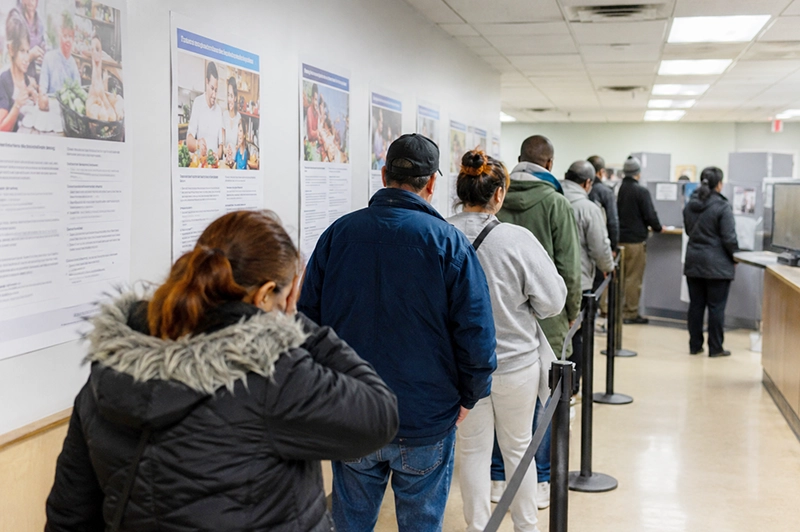
Stephen Grimaldi, executive director of New York Common Pantry, said food pantries across the city are helping more families whose government benefits have been reduced or terminated.
“When benefits disappear, families don’t just lose purchasing power—they lose stability,” Grimaldi said. “Even if benefits are eventually restored, people often spend months worrying about how they’ll feed themselves and their children.”
For many households, those concerns are deeply personal.
Mirian Romero, a 42-year-old East Harlem resident raising nine family members, said she now relies heavily on neighborhood food pantries to supplement her monthly SNAP allotment after previous benefit reductions. Living with disabilities that prevent her from working full time, Romero said balancing household expenses has become increasingly difficult.
“I try to make every dollar stretch,” she said while waiting at New York Common Pantry with several of her children. “I’m resourceful, but there are days when it feels overwhelming. Nobody should have to worry this much about putting food on the table.”
As implementation of the new federal requirements continues, city officials expect additional SNAP cases to be reviewed throughout the year. The long-term impact of the policy changes remains uncertain, but both government agencies and nonprofit organizations agree that the coming months will provide a clearer picture of how the revised work requirements affect food insecurity across New York City.