

Tucked between Manhattan’s Upper East Side and the industrial edges of Queens, Roosevelt Island is the city’s most quietly uncanny landscape — a sliver of land where history’s ruins sit beside sleek towers of glass and steel. For decades, it’s been called everything from “the forgotten borough” to “the city’s secret utopia.” But Roosevelt Island, with its mix of ghosts, greenery, and futuristic architecture, tells a story unlike anywhere else in New York.
An Island with a Past
Before it became Roosevelt Island, this narrow two-mile strip in the East River was known by several names — Blackwell’s Island, then Welfare Island — each reflecting the city’s evolving relationship with isolation. In the 19th century, it was a place for those society preferred to keep at arm’s length: the mentally ill, the poor, the imprisoned, and the sick.
The Gothic ruins of the Smallpox Hospital, completed in 1856 and now landmarked, still loom over the southern tip like a stone skeleton. Designed by James Renwick Jr., the same architect who built St. Patrick’s Cathedral, the crumbling façade remains fenced off but visible — a haunting monument to a chapter of public health history that feels eerily relevant in the post-pandemic era.
Nearby stood the New York City Lunatic Asylum, once a reformist experiment that quickly turned grim. Charles Dickens wrote about the island’s “lounging, listless madmen” in American Notes (1842), appalled by what he saw. Today, the asylum’s octagonal entryway survives as The Octagon, a luxury residential complex that integrates preservation with high-end living — a physical embodiment of the island’s transformation from confinement to comfort.
A Modernist Dream in the Middle of the River
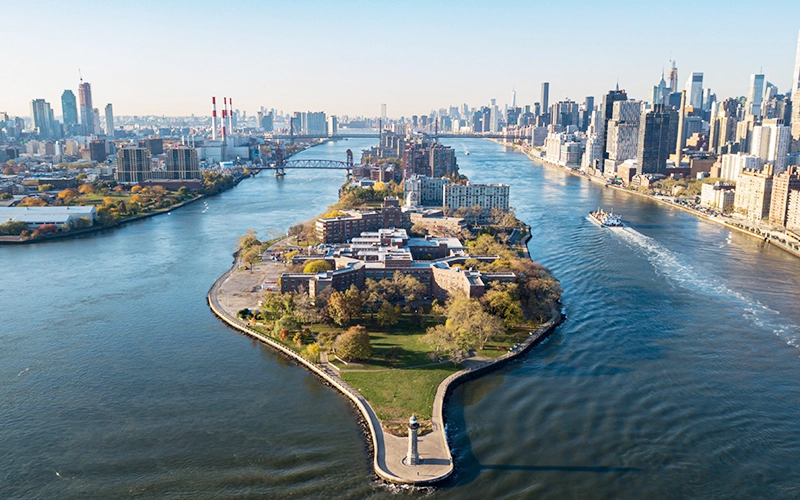
Roosevelt Island’s rebirth began in the 1970s, when New York City envisioned it as a model for socially balanced urban living — affordable housing, green spaces, and a car-free core. The result was a blend of idealism and brutalist architecture: red-brick towers by Josep Lluís Sert, elevated walkways, and concrete plazas meant to promote community interaction.
That vision never fully materialized. The island’s midcentury modernist ideal faded into the city’s larger narrative of boom and decay, but traces remain in the geometric facades of the Eastwood (now Roosevelt Landings) and the serene rhythm of its linear parks.
Today, the skyline is being rewritten again. The arrival of Cornell Tech in 2017 brought a new wave of glass and innovation to the island’s southern end. Its campus — anchored by the net-zero energy Bloomberg Center and the angular The House, one of the world’s most energy-efficient residential buildings — stands in stark contrast to the decayed stones of Renwick’s hospital just a few hundred yards away.
This juxtaposition — old New York’s ghosts beside Silicon Alley’s mirror towers — gives Roosevelt Island its singular identity. It’s a living museum of urban experimentation, equal parts dystopian and utopian.
What to See and Do
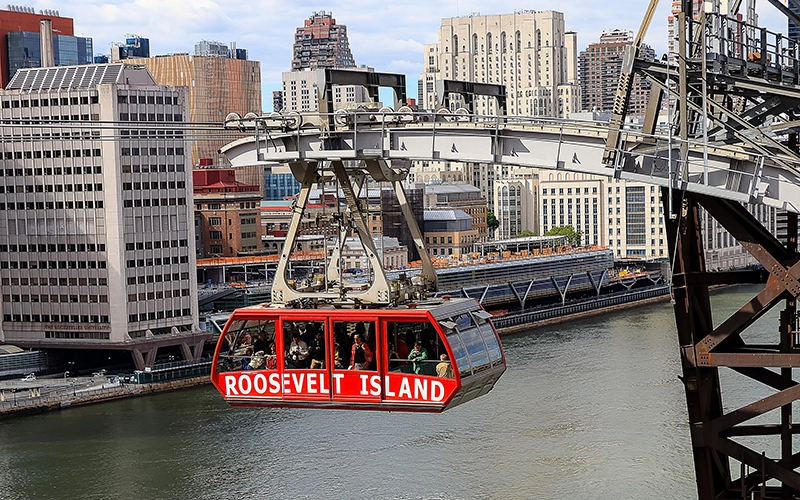
Start your journey with the Roosevelt Island Tram, still one of the city’s most cinematic rides. The tram soars 250 feet above the East River, offering sweeping views of midtown Manhattan before depositing passengers into what feels like a parallel New York — quieter, cleaner, and oddly suspended in time.
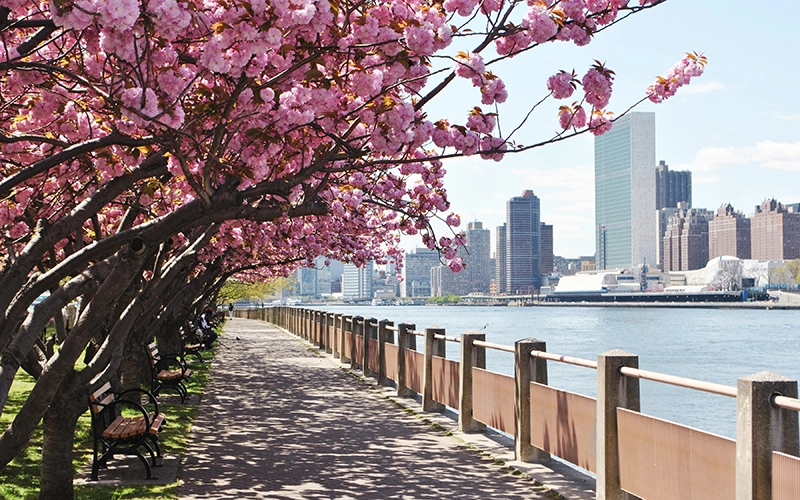
From there, take a leisurely walk south. You’ll pass the Cornell Tech campus, a study in minimalist architecture and sustainability, before reaching Franklin D. Roosevelt Four Freedoms State Park. Designed posthumously by Louis Kahn and opened in 2012, the park’s stark granite geometry frames both the skyline and FDR’s vision of human rights. Visit at sunset, when the light catches the East River currents and the city’s hum fades into a kind of meditative silence.
Heading north, the Octagon marks the threshold between history and contemporary living. Its central rotunda, once the asylum’s entry hall, now serves as a gallery and event space. Nearby, Lighthouse Park offers picnic lawns and sweeping views toward Randall’s Island, crowned by a small lighthouse built in 1872 by asylum inmates.
The island’s waterfront promenades are ideal for cycling or quiet evening walks. A single main street connects everything, lined with cafés, playgrounds, and pocket gardens. Despite its proximity to Manhattan, Roosevelt Island feels strangely detached — as though the city’s volume has been turned down a few notches.
Living Between Eras
Roosevelt Island has long been a study in contradictions: planned yet organic, isolated yet connected, haunted yet hopeful. Its layered identity — from asylums to academia, ruins to research labs — reflects New York’s own restless capacity for reinvention.
For visitors, the appeal lies in this tension. Stand between the glass facades of Cornell Tech and the skeletal remains of the Smallpox Hospital, and you can feel the city’s pulse oscillate between memory and ambition. Few places capture the full arc of New York’s story so vividly — its compassion and cruelty, its failures and futuristic optimism — all contained within this slim, wind-brushed island adrift in the East River.






Leave a Reply